5 Powerful Insights About NAD+ Cellular Health and the Aging Process
Longevity Science •
Mar 13, 2026 •
Table of Contents
Aging is something everyone experiences, yet for decades scientists struggled to explain exactly what drives the process at a cellular level. Traditionally, people assumed aging was mostly determined by genetics, lifestyle choices, or environmental exposure. While those factors certainly influence health and longevity, modern biology has revealed that many of the most important clues about aging are hidden much deeper — inside the microscopic systems that power our cells.
Over the last several years, one molecule has gained enormous attention among researchers studying metabolism and longevity: NAD+. Although it has existed in biology textbooks for decades, scientists are now beginning to understand how central this molecule may be to the way our bodies produce energy, repair cellular damage, and maintain metabolic balance.
My own curiosity about NAD+ began when reading research papers on cellular metabolism. Across different studies from different institutions, one observation kept appearing repeatedly: NAD levels decline with age. At first, it seemed like just another biochemical statistic buried inside complex data tables. But the more I read, the clearer it became that this small molecular change might actually explain a surprising amount about how cells gradually lose efficiency over time.
NAD+ participates in some of the most fundamental processes that keep cells alive and functioning. It plays a role in energy production, cellular signaling, and even DNA repair mechanisms. Because of these responsibilities, many researchers now believe that understanding NAD+ cellular health may help explain how cells maintain resilience and balance throughout life.
To fully understand why scientists are paying so much attention to this molecule, we need to start with a simple question: what is NAD+ and why has it become such a major focus in longevity research?
1. What Is NAD+? The Molecule Quietly Powering Your Cells
At first glance, NAD+ may sound like a complicated scientific abbreviation that only biochemists need to worry about. But in reality, it plays a role in almost every living cell in the human body.
NAD+ stands for nicotinamide adenine dinucleotide, a coenzyme that helps enzymes perform essential metabolic reactions. These reactions allow cells to convert nutrients from food into usable energy.
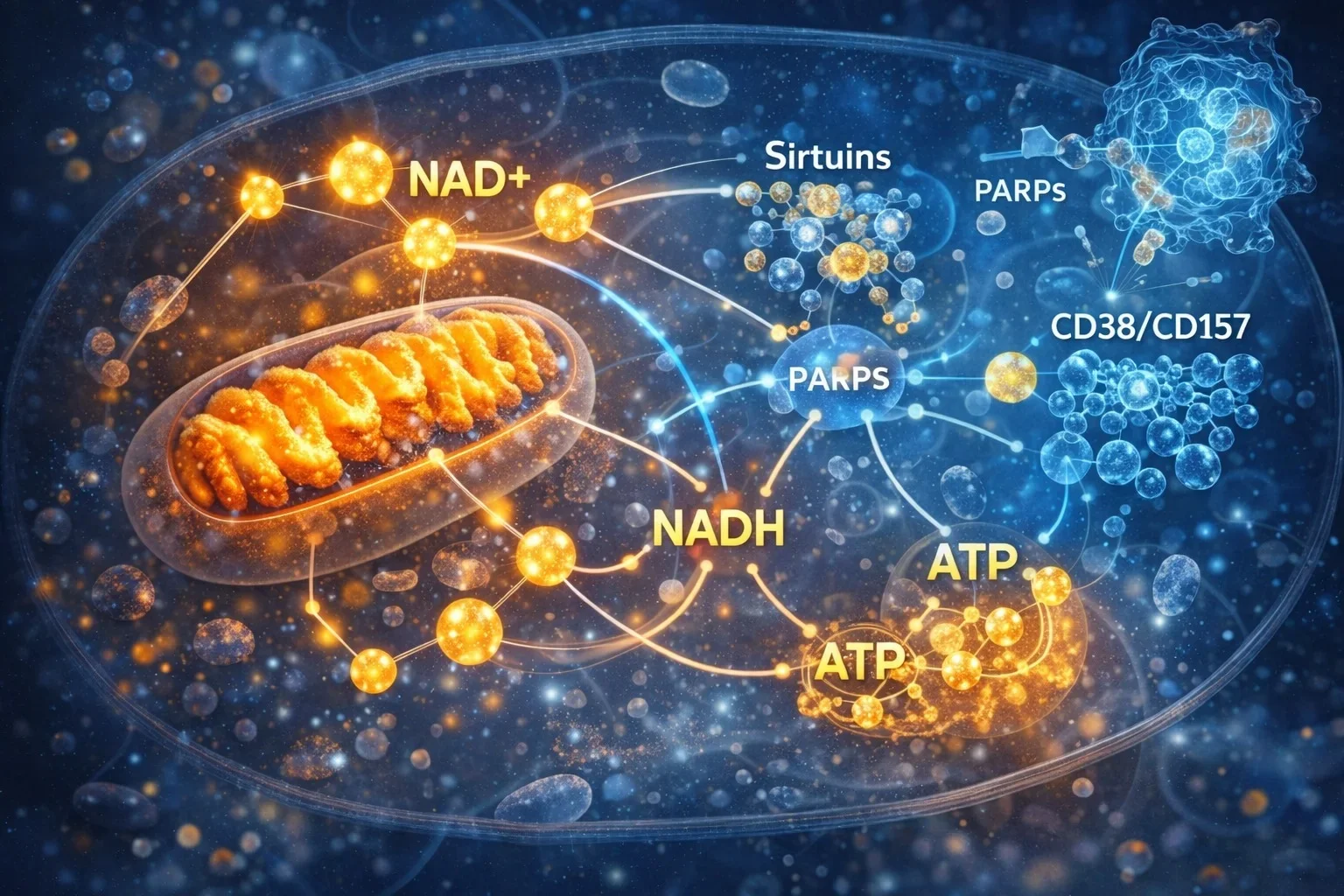
To understand the NAD+ function in cells, imagine the cell as a busy energy factory. Nutrients such as glucose and fatty acids enter the factory, and through a series of chemical reactions they are transformed into ATP, the molecule cells use as their primary source of energy. NAD+ acts as an essential helper in this process by carrying electrons between reactions, enabling energy to move through the metabolic system.
Without NAD+, many of these reactions would slow down dramatically. As a result, the cell’s ability to produce energy would decline.
This role becomes especially important when we look at mitochondria. Mitochondria are often described as the power plants of the cell because they generate ATP. These structures rely heavily on NAD+ to maintain efficient energy production.
When NAD+ levels are healthy, mitochondria function smoothly and cells are able to generate the energy they need. But when NAD+ levels fall, mitochondrial efficiency may decrease, which can affect overall cellular performance.
Researchers studying NAD+ cellular health often describe this molecule as a central regulator of metabolic activity because it connects multiple systems involved in energy production and cellular maintenance.
2. Why NAD Levels Decline With Age
One of the most intriguing discoveries in longevity science is that NAD levels decline with age across many organisms, including humans. This decline does not happen suddenly but rather develops gradually over time.
Several biological factors appear to contribute to this process.
First, the body’s ability to produce NAD+ naturally decreases with age. The metabolic pathways responsible for NAD metabolism may become less efficient as we grow older, reducing the amount of NAD+ available inside cells.
Second, aging cells tend to accumulate more molecular damage. Over time, DNA damage occurs naturally due to environmental stress, metabolic reactions, and normal cellular activity. Repairing this damage requires NAD+, which means cells consume the molecule more rapidly as they attempt to maintain stability.
Third, certain enzymes that break down NAD+ become more active with age. These enzymes reduce the available pool of NAD+ in tissues, further contributing to declining levels.
When these factors combine, they contribute to what researchers call the NAD+ aging process. As NAD+ availability decreases, cellular systems that depend on it — such as mitochondrial energy production and DNA repair — may gradually become less efficient.
Although aging is influenced by many factors, the decline of NAD+ appears to play an important role in how cells lose resilience over time.
3. How NAD Metabolism Supports Cellular Energy
To better understand the importance of NAD+, scientists often examine NAD metabolism, the complex system responsible for producing and recycling this molecule inside cells.
NAD metabolism includes several pathways that convert vitamin B3 derivatives — such as niacin, nicotinamide, and related compounds — into NAD+. These pathways help ensure that cells maintain a steady supply of this molecule even as it is constantly used in metabolic reactions.
Under healthy conditions, NAD metabolism maintains a balance between production and consumption. Cells continuously generate new NAD+ molecules while recycling those that have already been used.
However, when NAD production decreases or consumption increases, this balance can shift. Cells may struggle to maintain optimal NAD+ levels, which can influence metabolic efficiency.
Because mitochondria depend on NAD+ for energy production, disruptions in NAD metabolism can directly affect how efficiently cells produce ATP. Researchers studying NAD for longevity believe that maintaining healthy NAD metabolism may help support metabolic stability and cellular resilience throughout life.
For more information about what is nad, please watch our website
4. The Role of NAD+ in Cellular Repair and Longevity
Energy production is only one part of NAD+’s biological role. Another equally important function involves cellular repair systems.
Cells constantly experience small amounts of molecular damage due to environmental stress, metabolic activity, and normal biological processes. Fortunately, cells also have repair mechanisms designed to detect and fix this damage.
Many of these repair systems depend on NAD+.
Certain enzymes responsible for repairing DNA damage require NAD+ to function effectively. These enzymes help identify damaged sections of DNA and initiate repair processes that maintain genomic stability.
NAD+ also activates proteins known as sirtuins, which regulate stress responses and metabolic processes that help cells adapt to changing conditions.
Because of these functions, NAD+ has become closely linked to research exploring NAD for longevity. Scientists believe that maintaining balanced NAD+ activity may support cellular resilience and help cells maintain stability as the body ages.
While research is still evolving, the connection between NAD+ and cellular repair systems remains one of the most promising areas of longevity science.
5. Why NAD+ Cellular Health Matters for Aging Research
The concept of NAD+ cellular health has attracted growing attention because NAD+ influences several biological systems simultaneously.
These include mitochondrial energy production, DNA repair mechanisms, metabolic signaling pathways, and cellular stress responses. Because NAD+ interacts with so many systems at once, researchers believe it may play a central role in how cells maintain balance over time.
Understanding how NAD+ supports these systems may help scientists better explain how cells manage energy, repair damage, and adapt to stress as the body ages.
Although NAD+ is just one molecule among thousands inside the human body, its influence reaches across multiple biological processes. This broad impact explains why researchers continue to investigate how NAD+ levels change with age and how these changes affect cellular performance.
Key Functions of NAD+ in Human Cells
Cellular Function
Role of NAD+
Impact
Energy production
Transfers electrons during metabolism
Supports ATP generation
DNA repair
Activates repair enzymes
Maintains genomic stability
Sirtuin activation
Regulates longevity pathways
Supports metabolic balance
Stress response
Helps cells adapt to damage
Improves resilience
FAQ — Frequently Asked Questions
What is NAD+ in simple terms?
NAD+ is a coenzyme found in every cell that helps convert nutrients into energy and supports cellular repair systems.
Why do NAD levels decline with age?
Scientists believe this decline occurs due to reduced NAD production, increased cellular stress, and enzymes that break down NAD+ more rapidly.
What does NAD+ do in cells?
The NAD+ function in cells includes supporting energy production, activating repair enzymes, and regulating metabolic pathways.
How is NAD+ produced in the body?
NAD+ is produced through NAD metabolism pathways that convert vitamin B3 derivatives such as niacin into NAD+.
Why is NAD+ linked to longevity research?
Researchers studying NAD for longevity believe NAD+ influences several systems related to aging, including mitochondrial function and DNA repair.
Final Thoughts: Why NAD+ Is Becoming Central to Longevity Science
Although NAD+ is a small molecule, its influence on cellular biology is surprisingly broad. From energy metabolism to DNA repair systems, NAD+ helps coordinate processes that keep cells functioning efficiently.
As scientists continue studying NAD+ cellular health, this molecule is becoming one of the most important topics in modern aging research. Understanding what is NAD+ and how the NAD+ aging process unfolds may ultimately provide deeper insight into how cells maintain resilience throughout life. Interested in learning more about cellular longevity and metabolic health? Explore the latest scientific insights into NAD+ biology and discover how researchers are studying metabolic pathways that support healthy aging and cellular energy.